
Sub theme: Health and Human Rights: Enhancing the rights fulfilment of persons affected by leprosy in Asia.
Introduction
The Human Rights Conference (HRC) is an annual international conference organised by the Centre for Human Rights, Multiculturalism, and Migration (CHRM2), the University of Jember since 2016. The HRC is designed as an academic forum to facilitate dissemination and discussion of studies on issues concerning human rights, including civil, political, economic, social and cultural rights in Asia region, particularly in Indonesia and South East Asia. Since its first implementation, the HRC has attracted thousands of academia, researchers, social activists, human defenders, and development practitioners with various academic disciplines from different countries.
CHRM2 has always organised the HRC in collaboration with various national and international partners, including Sydney Southeast Asia Centre, University of Sydney, the Association of Human Rights Lecturers (Serikat Pengajar Hak Asasi Manusia or SEPAHAM Indonesia), the National Commission on Human Rights (Komisi Nasional Hak Asasi Manusia or KOMNAS HAM), The National Commission on Anti-Violence Against Women (Komnas Perempuan,) the Westminster Foundation for Democracy (WFD), Human Rights Centre of Malaya University, Ministry of Laws and Human Rights (Kementerian Hukum dan HAM), Indonesian Scholar Network on Freedom of Religion or Belief (ISFORB), The Australian Consulate General in Surabaya, and Asia Justice and Rights (AJAR). The 1st to the 5th HRC was organised at the University of Jember, however, starting from the 6th HRC, CHRM2 and partners decided to rotate the host of the HRC at other university partners in different cities, including Gadjah Mada University – Yogyakarta in 2023, Brawijaya University – Malang in 2024, and Airlangga university – Surabaya in 2025.
For 2026, the conference will focus on issues concerning peace, security and sustainability of human life divided into several sub-themes consisting of: health and human rights, women and human rights, disability and human rights, environmental justice, vulnerable groups, social inclusion, and science and human rights.
The HRC 2026 expects to receive over 1000 abstracts. The HRC will then select and invite 250 of them for live presentation at the HRC 2026.
- Special Plenary Panel and Parallel Sessions on “Leprosy and Human Rights: Enhancing respect, protection, fulfilment of the rights of persons affected by leprosy in Asia”.
Leprosy is a chronic infectious disease caused by Mycobacterium leprae, which affects the skin, peripheral nerves, the mucosa of the upper respiratory tract and the eyes. Leprosy is curable and preventable. However, inadequate, if not, no active case finding in most leprosy endemic countries has caused late detection, hence, delayed treatment of persons contracting leprosy. This has made many persons affected by leprosy developed physical deformity and disability. Persons affected by leprosy have been highly stigmatized and discriminated as well as excluded from their economic, social, and political rights in many endemic countries in the world.
As per data of 2024, countries in Asia continue reporting new leprosy cases with India and Indonesia reported the first and third biggest number of new leprosy cases. Not only do India and Indonesia still have leprosy cases, but also Bangladesh, Myanmar, Nepal, the Philippines, and Sri Lanka still report new cases.
In many parts of the world, including Asia, persons affected by leprosy and their family members continue to face multiple forms of discrimination and widespread barriers to their participation as equal members of society including isolation and violations of their human rights. The Human Rights Council aimed to intensify efforts to eliminate all forms of prejudice and discrimination against persons affected by leprosy and their family members, and to promote policies that facilitate their inclusion and participation by adopting Resolution 29/5 in June 2015. The Council then established a mandate for the Special Rapporteur on the elimination of discrimination against persons affected by leprosy and their family members for three years in 2017 (resolution 35/9) and extended it for another 3 years in July 2023 (resolution 53/8).
The HRC 2026 sees the importance of making scientific contribution to the above problems by inviting researchers with relevant papers to present in the conference and publish their papers in the special edition on ‘leprosy and human rights’.
The HRC 2026 will open one Panel in the Plenary Session under the theme of “Health and Human Rights” with a sub-theme of “Leprosy and Human Rights: Enhancing respect, protection, fulfilment of the rights of persons affected by leprosy in Asia”. The HRC 2026 will also invite and sponsor selected multidisciplinary papers to present in three parallel sessions of the HRC 2026.
The Panel of the above Plenary Session and the parallel sessions will be co-hosted by CHRM2 and NLR (No Leprosy Remains) Indonesia Foundation.
- Scientific Publication of Special Edition on Leprosy and Human Rights
CHRM2 and NLR Indonesia will select 8 best papers to be published at the Journal of Southeast Asian Human Rights, Volume 11, Number 2, December 2026.
- The Location and Venue of HRC 2026
The HRC 2026 will be organised in the City of Surakarta, Central Java, Indonesia. the conference venue will be located at the Faculty of Law, Sebelas Maret University, Jl. Sutami No. 36 A, Surakarta.
- Partial Sponsorship
NLR Indonesia will offer partial sponsorship for the selected best papers for their participations in the conference (to be discussed).
- Call for Abstracts
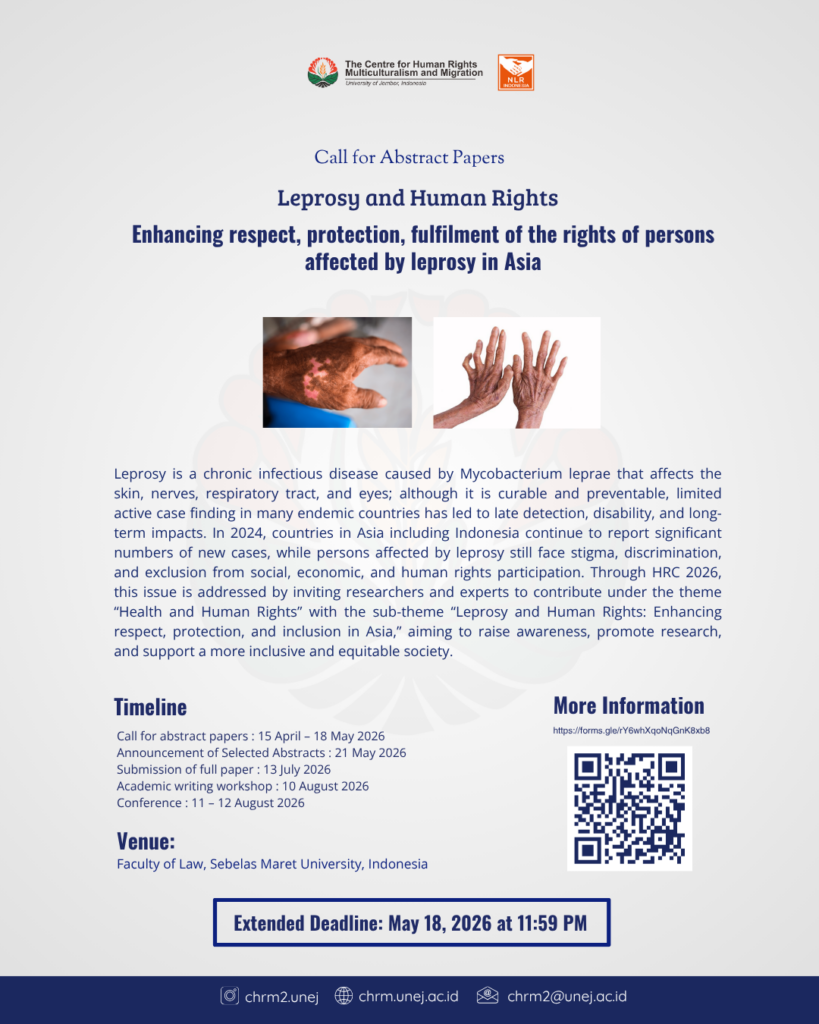
The 9th Human Rights International Conference 2026, co-hosted by CHRM2 and NLR Indonesia Foundation, calls for multi-disciplinary abstracts and papers under the following theme: “Leprosy and Human Rights: Enhancing respect, protection, fulfilment of the rights of persons affected by leprosy in Asia”.
This time-line of this call for abstracts and papers is as follows:
Call for abstract papers : 15 April – 18 May 2026
Announcement of Selected Abstracts : 21 May 2026
Submission of full paper : 13 July 2026
Academic writing workshop : 10 August 2026
Conference : 11 – 12 August 2026
- Websites Information on the HRC 2026